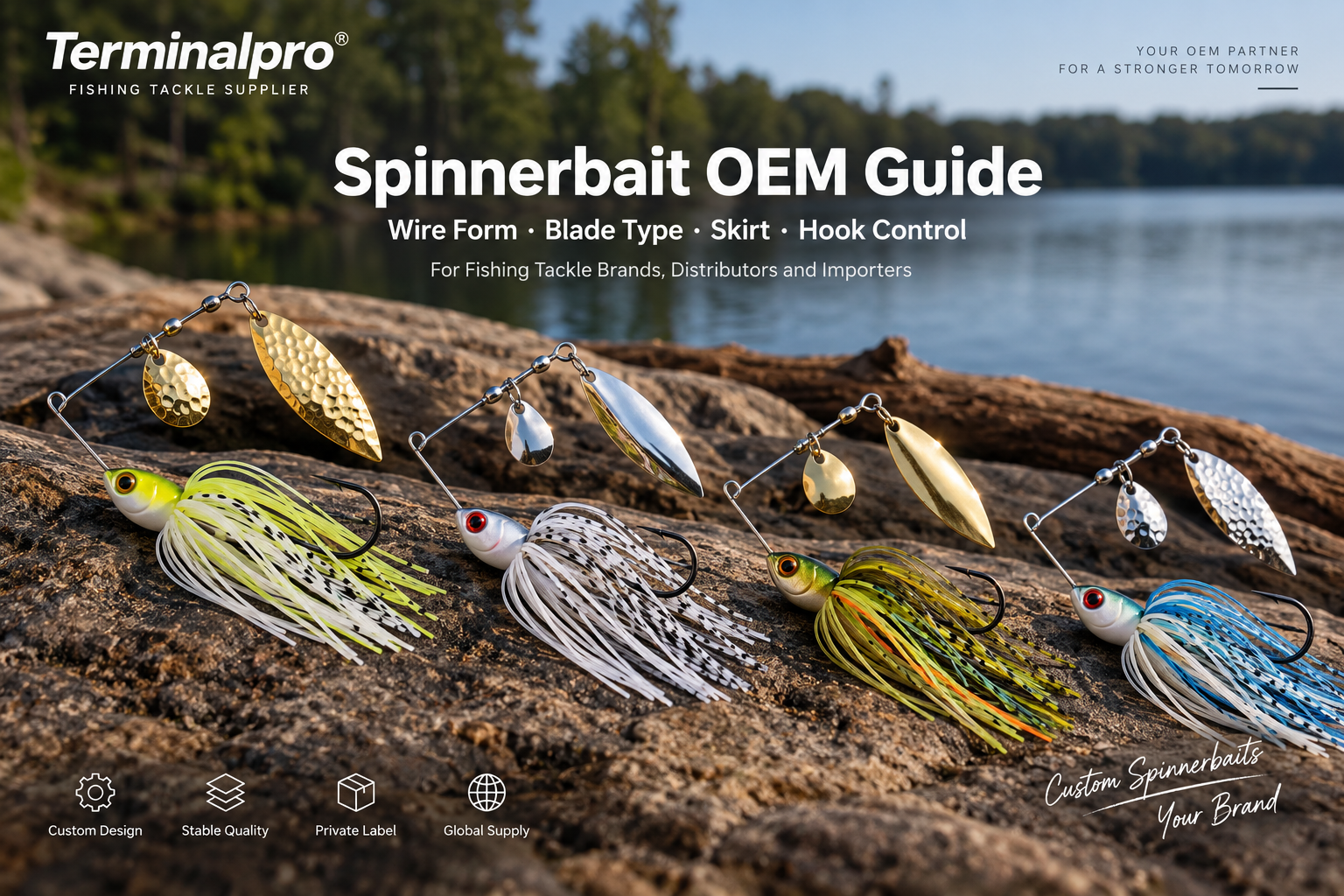
A spinnerbait OEM guide is useful for distributors, importers and fishing tackle brands that need stable bulk production, consistent lure action and retail-ready packaging. For professional buyers, spinnerbait sourcing is not only about head weight and skirt color. Wire form, blade rotation, hook quality, small components, packaging protection and repeat order consistency all affect whether the product can perform well in the market.
What This Spinnerbait OEM Guide Covers
- How distributors and brands define a spinnerbait product range
- Why wire form, blade type and arm angle affect lure action
- How hook quality, skirt fixing and small components influence performance
- What packaging and private label details buyers should prepare
- How quality control helps maintain repeat order consistency
Table of Contents
- Define the target market
- Check wire form and frame strength
- Choose blade type and rotation quality
- Confirm head weight and coating
- Select hook size and sharpness
- Control skirt material and fixing method
- Check swivels and small components
- Plan private label packaging
- Manage MOQ and SKU planning
- Inspect quality before shipment
- Prepare a complete RFQ checklist
Spinnerbaits are widely used in bass fishing and predator fishing markets. They are also practical products for distributors because one product family can include multiple weights, blade combinations, skirt colors and packaging styles. However, this also means that SKU control and specification management are important from the beginning.
This spinnerbait OEM guide is written for fishing tackle distributors, importers, established brands and product managers who need stable supply, consistent specifications and retail-ready spinnerbait products.
For buyers building a broader bass lure range, spinnerbaits are often planned together with jig heads, soft baits and other OEM fishing lures. A clear specification sheet helps the supplier quote accurately and helps the buyer avoid repeated sample changes.
For procurement teams, this spinnerbait OEM guide can also work as an internal checklist when comparing suppliers, reviewing samples and preparing repeat orders.
1. Use This Spinnerbait OEM Guide to Define the Target Market
The first step is to define the target market and product position. A spinnerbait for a budget retail range may use a standard head shape, regular hook and simple blister pack. A premium range may require stronger wire, sharper hooks, better blade finish, wire-tied skirts and more protective packaging.
Importers and distributors should confirm the fishing method, target fish, retail price level, sales channel and expected reorder plan. These details influence the choice of wire diameter, blade material, hook specification, skirt quality and packing method.
Common spinnerbait weights include 1/8 oz, 1/4 oz, 3/8 oz, 1/2 oz, 3/4 oz and 1 oz. For many bass fishing ranges, 3/8 oz and 1/2 oz are core sizes. Heavier sizes may be used for deeper water, larger fish or stronger current.
2. Define Wire Form, Diameter and Frame Strength
Wire form is one of the most important parts of spinnerbait production. The wire frame affects vibration, blade position, hook alignment and overall durability. A spinnerbait can look correct in packaging but still run poorly if the wire angle is wrong.
Buyers should confirm wire diameter, wire material, line tie style, upper arm length, lower arm length and frame angle. A thinner wire can create stronger vibration, but it may bend more easily during fishing or shipping. A thicker wire improves strength, but it may reduce vibration and change the lure action.
For bulk orders, wire consistency is important. If the arm angle changes between batches, the spinnerbait may run differently even when the head weight and blade sizes are the same.
3. Choose Blade Type, Size and Rotation Quality
Blade selection has a direct influence on flash, vibration, lift and running depth. Professional buyers should not treat the blade as only a decorative part.
Common blade types include willow blades, Colorado blades and Indiana blades. Willow blades are often selected for flash and faster retrieve. Colorado blades create stronger vibration and more lift. Indiana blades offer a balanced option between flash and vibration.
Spinnerbaits may use single blade, double blade or tandem blade configurations. A common combination is Colorado plus willow, but final selection should match the target market, water clarity, retrieve speed and product positioning.
Blade rotation should be tested during sample approval. If the swivel, clevis, bead spacing or blade hole is not correct, the blade may not start spinning smoothly. This is a small detail, but it can create real customer complaints after retail sales.
4. Confirm Head Weight, Shape and Coating Method
The spinnerbait head affects casting, swimming balance, weed resistance and shelf appearance. Common head styles include fish head, bullet head, wedge head and other custom profiles.
Buyers should confirm actual head weight, acceptable tolerance, body shape, eye style, coating method and color. Powder coating is commonly used for durability, while painted finishes may be selected for more detailed color effects.
If the project uses a custom head shape, the buyer should discuss tooling cost, sample lead time and mold modification process before confirming the order. For related lead head products, buyers can also review Terminalpro’s jig head OEM capability.
5. Select Hook Size, Wire Diameter and Sharpness Standard
Hook quality is a key purchasing point for spinnerbait OEM orders. A low-cost hook can reduce the total unit price, but it may also increase market complaints if the hook is not sharp enough or bends too easily.
In a spinnerbait OEM guide for professional buyers, hook selection should be treated as a performance and complaint-risk item, not only as a cost item.
Buyers should confirm hook size, hook style, wire diameter, point sharpness, barb shape and finish. Hook size should match head weight and target fish. A hook that is too small may reduce landing rate. A hook that is too large may affect lure balance and skirt movement.
For premium spinnerbait ranges, some brands may request specific hook brands or upgraded hook specifications. For a broader hook sourcing comparison, buyers can review Terminalpro’s fishing hooks product range.
6. Control Skirt Material, Color and Fixing Method
Skirt material and color influence both lure action and retail presentation. Silicone skirts are widely used because they provide good movement, many color options and stable production consistency.
Buyers should confirm skirt material, strand count, skirt length, color combination, flake effect and collar method. Common colors include white, chartreuse, black, bluegill, shad, perch, fire tiger, green pumpkin and other market-specific patterns.
The fixing method should be confirmed before production. Rubber collars are common and cost-effective. Wire-tied skirts may be used for higher-end products or buyers who need stronger durability. For distributors, approved skirt color samples should be kept for repeat orders.
7. Check Swivels, Clevises, Rings and Small Components
Spinnerbait performance depends heavily on small components. Swivels, clevises, split rings and beads are small in size, but they affect blade rotation, vibration, corrosion resistance and long-term durability.
A poor-quality swivel can reduce blade rotation. A weak split ring can open under pressure. A low-quality clevis may wear faster or make the blade rotate poorly.
Professional buyers should confirm whether the spinnerbait uses crane swivels, rolling swivels, ball bearing swivels or other connection methods. Buyers can also compare related terminal tackle components in Terminalpro’s swivels and snaps range.
8. Plan Private Label Packaging Before Final Quotation
Spinnerbaits are easy to deform if packaging is not planned correctly. The wire arm, blade and skirt all need protection during storage, carton packing and international shipment.
This spinnerbait OEM guide recommends confirming packaging before final pricing because packaging style can change labor cost, carton size and delivery planning.
Common packaging options include blister packs, clamshell packs, header bags, PVC boxes, paper cards and bulk packing. For private label orders, buyers should prepare logo artwork, barcode, SKU, weight, blade type, color name, hook information, warning text and country of origin details.
Packaging should not be confirmed after the unit price is finalized. A blister pack, clamshell pack and header bag can have very different costs, labor requirements and MOQ. For buyers selling through retail stores or distribution channels, Terminalpro’s custom packaging support can help align product, label and carton information before production.
For products sold in the European market, buyers may also need to review material and labeling requirements under REACH regulation, especially when coatings, metal components and packaging information are involved.
9. Manage MOQ, SKU Planning and Cost Structure
Spinnerbait MOQ is affected by head weight, wire form, blade finish, skirt color, hook choice, packaging method and total SKU structure. A simple product with standard components usually has a more flexible MOQ. Custom colors, special blades, upgraded hooks or private label packaging usually require better quantity planning.
For distributors, the challenge is often not one model, but the total number of SKUs. For example, five weights, six skirt colors and two blade combinations can quickly become a large product range. Buyers should identify core colors and key weights first, then expand the range after market feedback.
A practical RFQ should show quantity per weight, color and packaging style. This allows the supplier to calculate production cost, packaging cost and lead time more accurately.
10. Inspect Spinnerbait Quality Before Shipment
Spinnerbait quality control should cover structure, action, appearance and packaging. Key inspection points include wire alignment, arm angle, head weight, coating quality, hook sharpness, blade rotation, swivel quality, skirt fixing, color consistency and packing accuracy.
Before mass production, buyers should approve pre-production samples. These samples should be checked for swimming balance, blade rotation, hook quality, skirt movement and packaging fit.
For repeat orders, approved samples, blade specifications, skirt color standards, hook requirements and packaging samples should be kept as reference. Terminalpro’s process and quality control work focuses on reducing batch differences and helping buyers maintain stable supply.
11. Spinnerbait OEM Quotation Checklist for Professional Buyers
A complete RFQ is the practical output of this spinnerbait OEM guide. It helps suppliers provide accurate pricing and realistic production planning. It also helps professional buyers compare suppliers beyond simple unit price.
Spinnerbait OEM RFQ Checklist
- Target Market: Bass fishing, freshwater predator fishing, saltwater use or retail program
- Weight Range: 1/8 oz, 1/4 oz, 3/8 oz, 1/2 oz, 3/4 oz, 1 oz or custom weights
- Wire Form: Wire diameter, material, frame angle, arm length and line tie style
- Head Design: Fish head, bullet head, wedge head or custom head shape
- Blade Setup: Willow, Colorado, Indiana, single blade, double blade or tandem blade
- Blade Finish: Nickel, gold, painted, hammered, holographic or custom finish
- Hook: Hook size, hook type, wire diameter, coating and sharpness requirement
- Skirt: Silicone skirt, color combination, strand count, length and collar method
- Small Components: Swivel type, clevis, bead, split ring and corrosion resistance requirement
- Packaging: Blister pack, clamshell, header bag, PVC box, paper card or bulk packing
- Quantity: Quantity per weight, color, blade setup and packaging style
- Reference: Photos, physical samples, drawings or target product specification
Conclusion
A successful spinnerbait OEM guide should help buyers move from a general product idea to a clear production specification. For distributors, importers and fishing tackle brands, the key is not only choosing attractive colors. Wire form, blade rotation, hook quality, skirt fixing, packaging protection and quality inspection all affect customer satisfaction and repeat order stability.
Terminalpro supports professional fishing tackle buyers with spinnerbaits, jig heads, metal jigs, hard baits, soft baits, hooks, swivels, snaps and other terminal tackle products.
You can also download our fishing accessories catalog to review more product options and prepare your next OEM order.
Need a Spinnerbait OEM Quotation?
Send us your spinnerbait weight range, wire form, blade type, skirt colors, hook requirement, packaging idea and estimated quantity. Terminalpro will review your project and provide a practical OEM quotation for bulk production.
FAQ
What information is needed for a spinnerbait OEM quotation?
Buyers should provide weight range, wire form, blade type, blade finish, hook specification, skirt color, packaging method and estimated quantity per SKU.
What affects spinnerbait OEM cost?
Main cost factors include head weight, wire diameter, blade type, blade finish, hook quality, skirt material, small components, packaging method and total order quantity.
Can spinnerbaits be made with private label packaging?
Yes. Spinnerbaits can be packed in blister packs, clamshell packs, header bags, PVC boxes, paper cards or bulk packaging with private label artwork, barcode and SKU information.
Why is blade rotation important in spinnerbait quality control?
Blade rotation affects vibration, flash and lure action. During sample approval, buyers should check whether the blade starts spinning smoothly and whether the swivel, clevis and blade size are matched correctly.
How can distributors keep spinnerbait quality consistent across repeat orders?
Distributors should keep approved samples, wire specifications, blade details, skirt color standards, hook requirements and packaging samples as references for future production batches.