For many fishing tackle brands, distributors, and importers, preparing a clear jig head OEM quotation request is the first step to getting accurate pricing and reducing repeated communication with suppliers. Although jig heads look simple, an OEM jig head project often involves many details: hook model, head shape, weight, coating, eye design, packaging, quantity, and market requirements.
What This Guide Covers
- How to define jig head style and weight range
- How hook specification affects OEM quotation
- When a new mold is needed
- How coating, eyes and packaging affect cost
- What buyers should prepare before contacting a jig head supplier
When these details are unclear, the quotation process can become slow. The supplier may need to ask many follow-up questions, and the buyer may receive an estimated price that later changes after the final specifications are confirmed.
To make the quotation process faster and more accurate, it is important to prepare the key project information before contacting a jig head supplier. This article explains what buyers should prepare before requesting an OEM jig head quotation.
1. Confirm the Target Jig Head Style
The first step is to define the jig head style you want to produce.
Different fishing markets use different jig head shapes. Some are designed for soft plastics, some for bucktail jigs, some for vertical jigging, and some for freshwater or saltwater use. Even if the weight is the same, the head shape can affect mold cost, hook position, swimming action, packaging, and final price.
Common jig head types include:
- Round head jig heads
- Football jig heads
- Bullet head jig heads
- Shad head jig heads
- Erie head jig heads
- Stand-up jig heads
- Weedless jig heads
- Bucktail jig heads
- Jig heads with spinner blade
- Saltwater heavy-duty jig heads
If you already have drawings, photos, samples, or reference products, it is best to provide them at the beginning. A clear reference can help the supplier understand the product quickly and avoid misunderstanding.
If you only have a general idea, you can describe the target fishing method, target fish species, and sales market. A professional supplier can then suggest suitable shapes and production options.
2. Provide the Weight Range
Weight is one of the most important factors in a jig head quotation.
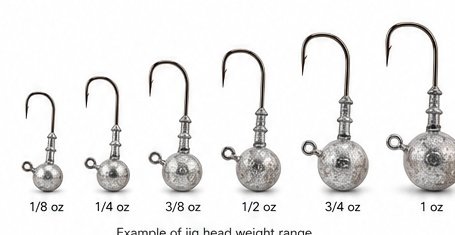
For example, a jig head range may include 1/16 oz, 1/8 oz, 1/4 oz, 3/8 oz, 1/2 oz, 3/4 oz, and 1 oz. For European or other metric markets, the weight may be listed in grams, such as 3 g, 5 g, 7 g, 10 g, 14 g, 20 g, and 30 g.
The supplier needs to know the full weight range because different sizes may require different cavities, molds, hooks, packaging arrangements, and production planning.
If you are developing a new mold, the supplier also needs to know whether all sizes should share the same design style. For example, a 5 g jig head and a 30 g jig head may look similar, but the hook size, eye position, and body proportions may need adjustment.
When preparing a quotation request, it is better to provide a simple weight table with estimated quantities for each size.
| Weight | Hook Size | Color | Estimated Quantity |
|---|---|---|---|
| 1/8 oz | #1 | Black Nickel | 5,000 pcs |
| 1/4 oz | 1/0 | Black Nickel | 5,000 pcs |
| 3/8 oz | 2/0 | Black Nickel | 3,000 pcs |
| 1/2 oz | 3/0 | Black Nickel | 3,000 pcs |
This helps the supplier calculate material cost, hook cost, coating cost, labor cost, and packaging cost more accurately.
3. Confirm the Hook Specification
The hook is a major cost factor in jig head production.
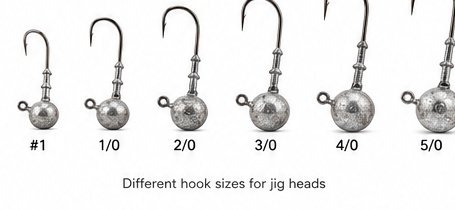
Different hooks can create a big price difference, even when the jig head weight is the same. A standard hook, a chemically sharpened hook, a black nickel hook, a tin-plated saltwater hook, or a branded hook can all affect the final quotation.
Before requesting a quotation, buyers should try to confirm:
- Hook size
- Hook shape
- Hook wire diameter
- Hook finish
- Hook strength requirement
- Freshwater or saltwater use
- Standard hook or branded hook
- Barbed or barbless design
If your market requires a specific hook brand or hook model, please mention it clearly. If you do not have a fixed hook requirement, the supplier can recommend a suitable hook based on the target market and price level.
For OEM projects, hook selection should not only focus on cost. The hook must match the target fishing method, soft bait size, fish species, and market positioning. A low-cost hook may reduce the product price, but it may also affect product performance and customer satisfaction.
4. Decide Whether a New Mold Is Needed
For jig head OEM projects, one key question is whether the product can use an existing mold or needs a new custom mold.
Using an existing mold is usually faster and more cost-effective. It is suitable for buyers who want to test the market, launch a new product range quickly, or control initial investment.
A new mold is more suitable when:
- You need a unique head shape
- You want your own brand style
- The hook angle must be customized
- The eye position must be different
- The product needs a special bait keeper
- The jig head must match a specific soft lure
- The market already has too many similar products
If a new mold is required, the buyer should prepare drawings, samples, or clear reference images. In some cases, the development process may include 3D drawing, prototype samples, mold production, mold testing, and pre-production samples.
A custom mold can improve product uniqueness, but it also requires additional cost and time. Therefore, buyers should consider whether the expected order volume and market plan justify the mold investment.
5. Confirm the Surface Finish and Coating
Jig heads can be supplied in many finishes. The most common options include plain lead, painted finish, powder coating, epoxy coating, UV coating, glitter coating, two-tone painting, and glow-in-the-dark finish.
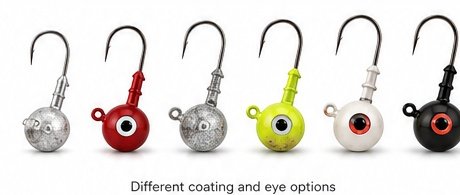
The coating method affects both appearance and cost. A simple one-color painted jig head is usually more economical. A multi-color finish, detailed eyes, UV effect, or epoxy topcoat will increase labor time and production cost.
For saltwater jig heads, coating durability becomes more important. The buyer should consider whether the product will be used in freshwater, saltwater, rocky areas, or heavy-duty fishing conditions.
If color accuracy is important, it is better to provide Pantone color references or physical samples. Photos can be useful, but colors may look different under different lighting and screens.
For branded products, it is also recommended to confirm whether the coating must pass any internal quality standard, such as salt spray test, scratch resistance, or long-term storage requirements.
6. Prepare Eye and Detail Requirements
Many jig heads include 3D eyes, painted eyes, holographic eyes, or molded eye sockets.
Although this looks like a small detail, it can affect cost and production process. For example, 3D eyes require additional material and manual application. Epoxy coating over the eye can improve durability but also increases production time.
Buyers should confirm:
- With or without eyes
- Painted eyes or 3D eyes
- Eye size
- Eye color
- Holographic or standard eye
- Whether epoxy cover is required
If the jig head includes a bait keeper, wire keeper, collar, or special barb design, these details should also be confirmed before quotation.
7. Confirm Packaging Requirements
Packaging is often underestimated in OEM jig head projects.
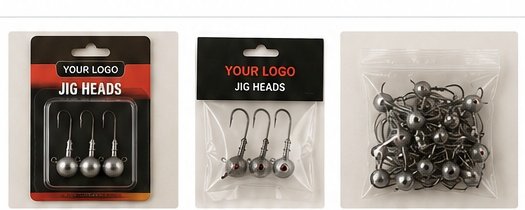
For wholesale bulk orders, jig heads may be packed in polybags, inner boxes, and export cartons. For retail products, packaging may include blister cards, header bags, PVC boxes, clamshell packs, paper cards, stickers, barcodes, and private label designs.
Before requesting a quotation, buyers should prepare basic packaging information:
- Bulk packing or retail packing
- Pieces per pack
- Pack size
- Card or label design
- Barcode requirement
- Warning label requirement
- Country of origin marking
- Language requirement
- Inner box and carton requirement
For private label products, packaging artwork can be prepared later, but the packaging style and quantity should be confirmed early because packaging cost and MOQ can affect the total price.
For example, a jig head packed 2 pcs per blister card will have a different cost from the same jig head packed 10 pcs per polybag. Retail packaging also increases labor cost, packing time, and carton volume.
8. Estimate the Order Quantity
Quantity is essential for an accurate quotation.
Many buyers ask for a price without providing estimated quantity, but jig head production cost is closely related to order volume. Mold cost, setup cost, painting cost, hook purchase quantity, packaging MOQ, and labor arrangement can all be affected by quantity.
A good quotation request should include:
- Total order quantity
- Quantity per size
- Quantity per color
- Quantity per packaging style
- Trial order or regular order plan
If the first order is for market testing, buyers can explain this clearly. The supplier may suggest a more practical combination of existing molds, standard colors, and flexible packaging to reduce initial cost.
For long-term OEM projects, the buyer can also share the expected annual demand. This helps the supplier evaluate whether custom molds, special hooks, or customized packaging are reasonable.
9. Clarify Compliance and Market Requirements
Different markets may have different compliance requirements for fishing tackle products, especially for lead products, packaging labels, and chemical substances.
Before placing an OEM jig head order, buyers should consider whether the target market requires:
- Lead warning label
- Proposition 65 warning for the U.S. market
- REACH consideration for the European market
- Barcode or SKU system
- Country of origin marking
- Child safety warning
- Retail chain packaging requirements
Not every project has the same requirement, but it is better to discuss these points early. If the product will be sold to large retailers, compliance and packaging standards may be stricter than normal wholesale orders.
For products sold in the European market, buyers may also need to consider REACH requirements depending on the product material and market channel.
10. Prepare Samples or Reference Products
If possible, sending a physical sample is one of the best ways to improve quotation accuracy.
A sample helps the supplier check:
- Actual head shape
- Hook angle
- Hook wire diameter
- Surface finish
- Eye size
- Bait keeper structure
- Weight tolerance
- Packaging method
- Overall quality level
Photos and drawings are useful, but a physical sample gives more accurate information. This is especially important when the buyer wants to match an existing product or improve an old design.
If sending samples is not possible, clear photos from different angles, product dimensions, and weight details can also help.
11. Build a Clear Quotation Request
A complete jig head OEM quotation request does not need to be complicated. The key is to provide enough information in a clear format.
Jig Head OEM Quotation Checklist
- Product: Custom jig head
- Market: Australia / Europe / USA / etc.
- Fishing Use: Soft plastic lure / saltwater / freshwater / bass / pike / snapper / etc.
- Head Shape: Round head / shad head / custom design / reference sample
- Weight Range: 1/8 oz, 1/4 oz, 3/8 oz, 1/2 oz
- Hook: Size, finish, wire strength, brand if required
- Color: Plain lead / black / red / glow / custom colors
- Eyes: 3D eyes / painted eyes / no eyes
- Packaging: Bulk / blister card / header bag / private label
- Quantity: Quantity per size and color
- Mold: Existing mold acceptable or custom mold required
- Compliance: Lead warning, REACH, Prop 65, barcode, etc.
- Target Price Level: Economy / standard / premium
Conclusion
A jig head may look simple, but an OEM project includes many details that affect cost, lead time, and product performance. Before requesting a quotation, buyers should prepare the basic specifications: head style, weight range, hook, coating, eyes, packaging, quantity, and market requirements.
The more complete the information, the faster and more accurate the quotation will be. It also helps both buyer and supplier avoid repeated communication, unexpected cost changes, and production delays.
At Terminalpro, we support importers, fishing tackle brands, and distributors with OEM fishing lures and private label jig head projects. Whether you need standard jig heads, custom molds, painted finishes, retail packaging, or complete product development support, our team can help prepare a practical solution based on your target market and order plan.
You can also download our fishing accessories catalog to review more product options for jig heads, fishing lures, swivels, snaps, sinkers and other terminal tackle products.
For your next jig head OEM project, you can send us your drawings, samples, photos, weight list, hook requirements, and packaging ideas. We will review the details and provide a clear quotation based on your specifications.
Need a Jig Head OEM Quotation?
Share your specifications, drawings, samples, or packaging ideas with Terminalpro. Our team will review your project details and provide a practical quotation for your market.
FAQ
What information is needed for a jig head OEM quotation?
For a jig head OEM quotation, buyers should provide the head shape, weight range, hook size, hook finish, coating color, eye requirement, packaging method, order quantity, and target market. Photos, drawings, or physical samples are also very helpful.
Can I use an existing jig head mold instead of making a new mold?
Yes. If your design is close to an existing mold, using an existing mold can reduce development cost and lead time. A new mold is recommended when you need a unique shape, special hook angle, custom bait keeper, or exclusive product design.
What affects the price of custom jig heads?
The main cost factors include lead weight, hook type, coating method, eye design, labor process, packaging style, quantity, and whether a new mold is required. Branded hooks, multi-color painting, epoxy coating, and retail packaging usually increase the cost.
What is the normal MOQ for OEM jig heads?
MOQ depends on the jig head size, hook, color, packaging, and mold situation. Standard designs with existing molds usually have more flexible MOQ. Custom colors, private label packaging, or new molds may require higher quantities.
Can jig heads be packed with private label packaging?
Yes. Jig heads can be packed with blister cards, header bags, labels, stickers, barcodes, or customized retail packaging. Buyers should prepare packaging style, pieces per pack, artwork, barcode, and market warning requirements.
Do jig heads need compliance labels?
This depends on the target market. For lead products, some markets may require lead warnings or chemical compliance notices. Buyers should confirm local regulations and retailer requirements before mass production.