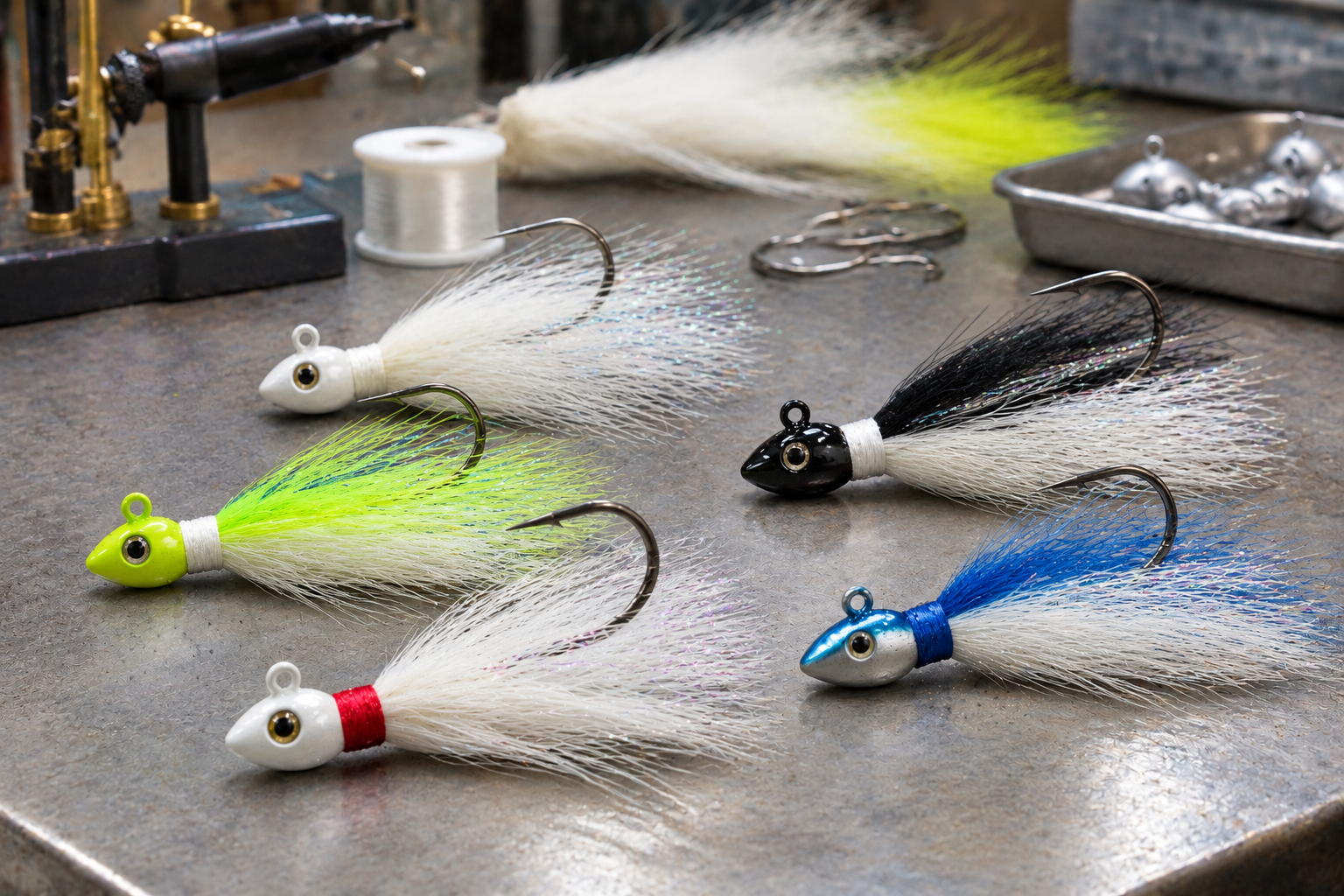
A bucktail jig may look like a relatively simple fishing lure, but producing a consistent retail product involves several components working together. The lead head, hook, natural hair, synthetic flash fibers and tying process all influence the finished lure. For fishing tackle brands and importers, a successful bucktail jig OEM project starts with a clear product specification rather than a color reference or a target unit price alone.
This guide explains nine important points buyers should review when developing a bucktail jig range, from head design and hook selection to hair density, tying quality, packaging and repeat-order control.
Why Bucktail Jig Specifications Matter in OEM Production
A bucktail jig is a complete lure, not simply a lead head with some hair attached. Its performance and retail appearance depend on the relationship between the head, hook and dressing.
A change in head weight can affect sinking speed. A different hook pattern can change the available gap and overall lure proportions. A fuller hair dressing may create a larger profile, while the amount and placement of flash fibers can change the visual appearance.
For distributors and established fishing brands, these details also affect product consistency. A sample may look excellent, but if hair length, density or tying quality varies across bulk production, the difference becomes visible on retail shelves.
1. Define the Fishing Application Before Choosing the Design
The first step in a bucktail jig OEM project is to define where and how the product will be used. A jig developed for freshwater predator fishing may require a different weight range, hook strength and dressing profile from a heavier saltwater model.
Buyers should establish the following before discussing detailed specifications:
- Target fish species and fishing market.
- Freshwater or saltwater application.
- Shallow-water or deeper-water presentation.
- Casting, vertical jigging or other intended retrieve methods.
- Expected product positioning: economy, standard or premium.
These details help determine the appropriate head weight, hook model and overall dressing size. They also help the supplier understand whether the project needs an existing design or a more customized product.
2. Select the Head Shape and Eyelet Position Together
The lead head is one of the most important structural components of a bucktail jig. Its shape, weight distribution and line-tie position can influence how the lure moves through the water.
Different manufacturers use different head profiles. Oval, streamlined and other specially shaped heads are common in commercial bucktail jig ranges.
For example, VMC’s BKJ Bucktail Jig uses an oval-shaped head designed around control and balance. SPRO’s Bucktail Jig range also highlights the relationship between head shape, eyelet placement and gliding action.
These examples demonstrate why buyers should not select a head solely by appearance.
Specifications to confirm:
- Head profile and overall dimensions.
- Lead head weight.
- Line-tie position and angle.
- Hook position relative to the head.
- Paint finish and eye details.
- Whether an existing mold can be used or new tooling is required.
If a buyer has a reference product, sending a physical sample or dimensioned drawing is preferable to relying on photographs alone.
3. Match Head Weight with the Intended Hook and Product Size
Weight and hook size should be developed as a product combination. Increasing the head weight does not automatically mean that every other component should increase proportionally.
A lightweight model may use a smaller hook, while a heavier version may require a larger or stronger hook. The actual combination depends on the intended fishing application, lure proportions and target fish.
Commercial products provide useful examples. VMC’s published BKJ range includes weights from 1/32 oz to 1 oz, with hook sizes ranging from size 6 to 4/0 across different models. This is a product-specific specification, not a universal weight-to-hook standard.
For an OEM project, buyers should prepare a weight and hook matrix rather than simply listing several weights.
| Specification | What Buyers Should Confirm |
|---|---|
| Head weight | Target weight for each SKU |
| Hook size | Exact hook model and size reference |
| Hook wire | Diameter and required strength |
| Hook gap | Clearance for the intended lure presentation |
| Overall length | Head-to-tail dimensions of the finished lure |
For a multi-weight product range, approve each important combination before bulk production. This helps prevent one size from having a noticeably different appearance or proportion from the others.
4. Choose the Hook by Its Actual Specifications
Hook size is an important purchasing detail, but the nominal size alone is not enough.
Different hook manufacturers may use different dimensions for the same nominal size. Hook length, gap, wire diameter, bend and point design can all vary.
For bucktail jigs, the hook should be evaluated together with the dressing. A bulky hair profile should not unnecessarily obstruct the intended hook gap or make the hook difficult to expose when fishing.
Buyers should confirm:
- Hook model and manufacturer reference, if applicable.
- Nominal size and actual dimensions.
- Wire diameter and strength requirement.
- Point sharpness and barb design.
- Hook finish and corrosion resistance for the target market.
- Hook alignment and position after assembly.
For branded programs, using the same approved hook model across repeat orders is particularly important. A change of hook supplier or pattern can affect both product appearance and performance.
See TerminalPro’s fishing hook product range for hook types and specifications used in lure production.
5. Select Natural Bucktail and Synthetic Dressing Materials
The dressing is what gives a bucktail jig its characteristic profile. Natural bucktail hair and synthetic fibers can be used individually or in combination, depending on the product design.
Natural bucktail has naturally varying fiber thickness and taper. This contributes to its distinctive appearance and movement. Synthetic flash fibers, including Flashabou-type materials, are often added to create additional visual reflection.
Some commercial products combine natural bucktail with tinsel fibers. Mepps, for example, describes a bucktail and Flashabou combination in its Bucktail Jig product information.
For OEM buyers, the important point is to define the material combination rather than simply requesting a particular color.
Material details to confirm:
- Natural bucktail, synthetic hair or a mixed dressing.
- Required hair color and color distribution.
- Fiber length and approximate thickness.
- Flash material type and color.
- Amount of flash relative to the natural hair.
- Consistency of material appearance between batches.
If a premium product requires natural bucktail, material selection and grading should be part of the sample approval process. Different batches of natural material may not look identical, so the buyer should agree on acceptable visual variation.
6. Control Hair Length and Dressing Density
Hair length and density are two details that can make the same bucktail jig design look like two different products.
Longer hair creates a different overall silhouette from a shorter dressing. A fuller dressing gives the lure a larger visual profile, while a lighter dressing exposes more of the hook and produces a different appearance.
There is no single correct hair length or density for every bucktail jig. These specifications should match the intended product and target market.
For sample approval, buyers should check:
- Hair length measured from the defined tying point.
- Overall finished lure length.
- Hair density and distribution around the hook shank.
- Consistency of the left and right sides.
- Whether the dressing maintains the intended hook exposure.
- Appearance when the dressing is wet, not only when dry.
The wet test is particularly useful. A dressing that looks full and symmetrical when dry may behave differently after being submerged. Buyers should review the actual lure in water before approving a new design.
7. Confirm Flash Placement, Color Combination and Head Finish
Color selection is often one of the most important retail decisions for fishing tackle brands. However, the overall color of a bucktail jig depends on more than the hair itself.
The lead head, natural hair, flash fibers, thread and eye details all contribute to the finished appearance.
A white dressing with silver flash, for example, creates a different visual effect from a black-and-white dressing with a smaller amount of reflective material. The placement of flash can also change the appearance of the lure.
Buyers should prepare a color reference sheet for each SKU, including:
- Lead head color and coating finish.
- Main bucktail color.
- Secondary hair or accent color.
- Flash fiber color and approximate proportion.
- Thread color.
- Eye color and size.
Head paint should also be inspected for consistent coverage, visible defects and adhesion. If 3D eyes are included, their size, position and attachment should match the approved sample.
A practical approach is to approve one physical sample for every key color combination rather than using a single sample to represent an entire color range.
8. Check Tying Security and Assembly Consistency
Tying quality is a critical part of bucktail jig production. Even when the head, hook and hair materials are correct, poor tying can lead to loose fibers, uneven dressing and inconsistent product appearance.
The tying process should secure the dressing around the hook shank and maintain the intended distribution of fibers. If several material layers are used, their placement and attachment should be consistent.
Important inspection points include:
- Hair is securely attached to the hook shank.
- No obvious loose bundles or untied fibers.
- Thread wrapping is neat and consistent.
- Flash fibers are distributed as specified.
- Dressing is reasonably symmetrical.
- Head and hook are correctly aligned.
- Adhesive or finishing material does not create unwanted visible defects.
A simple pull and handling check can help identify loose dressing before packaging. The inspection method should be agreed with the buyer and applied consistently during production.
9. Plan SKU Structure, Packaging and Final Quality Control
A bucktail jig range can quickly become complicated when several weights, hook sizes, colors and packaging formats are combined.
For established brands and distributors, it is usually better to plan the product range around expected demand instead of adding too many variations to the initial order.
A practical SKU plan should identify:
- Weight and hook size for each model.
- Color combinations and product codes.
- Quantity per SKU.
- Pieces per retail pack.
- Packaging type and label information.
- Expected reorder quantities.
Packaging should also be tested with the finished lure. Hair dressing can be compressed if the pack is too tight, while exposed hooks need suitable protection to prevent damage and tangling.
Common options include individual bags, header bags, blister cards and customized retail packs. The appropriate choice depends on the product size, retail channel and order quantity.
See TerminalPro’s custom fishing tackle packaging solutions for packaging formats and buyer preparation details.
Final Bucktail Jig QC Checklist
| Inspection Item | What to Check |
|---|---|
| Head | Weight, shape, paint coverage and eye position |
| Hook | Size, wire, sharpness, alignment and finish |
| Hair | Length, density, color and distribution |
| Flash | Material, placement and color consistency |
| Tying | Security, neatness and fiber retention |
| Assembly | Overall proportions and approved sample match |
| Packaging | Pack count, SKU label, product protection and barcode |
For a more complete inspection approach, buyers can also refer to TerminalPro’s Fishing Tackle Quality Control Checklist.
What Should Buyers Send for a Bucktail Jig OEM Quotation?
A clear inquiry helps suppliers review the product structure and provide a more accurate quotation. The following information is useful when starting a new bucktail jig project.
Bucktail Jig OEM RFQ Checklist
- Product reference: Photos, physical samples or drawings.
- Head design: Shape, dimensions and line-tie position.
- Weight: Required weight range by SKU.
- Hook: Model, size, wire diameter and finish.
- Dressing: Natural bucktail, synthetic material or mixed fibers.
- Hair: Length, density and color combination.
- Flash: Fiber type, color and approximate proportion.
- Finish: Head paint, eyes and other details.
- Quantity: Estimated quantity by weight and color.
- Packaging: Bulk bags, header bags, blister cards or retail packs.
- Market: Target country and intended fishing application.
If the project is based on an existing product, a physical reference sample is particularly useful. It allows the supplier to review the head, hook, dressing and assembly together before preparing the production proposal.
Conclusion: Consistency Matters More Than Adding More Variations
A successful bucktail jig range is built around a clear relationship between head weight, hook specification, dressing materials and tying quality. These components should be developed and approved together rather than treated as separate purchasing items.
For brands and importers, the priority should be to establish a reliable core range with clear specifications and repeatable production standards. More colors, weights and variations can be introduced once the initial product range has been validated.
TerminalPro works with long-term production partners for lead fishing products, jig heads, bucktail jigs and related fishing tackle components. We can review product references, head designs, hook requirements, dressing combinations and packaging plans for OEM projects.
For buyers planning a new bucktail jig range, send us your reference samples, specifications and estimated quantities. We can review the product structure and discuss a suitable production route.
Developing a Bucktail Jig Range for Your Brand?
Share your product samples, head specifications, hook requirements, hair colors and estimated order quantities. We can review the project and discuss the appropriate OEM production arrangement.
Frequently Asked Questions
What materials are commonly used in bucktail jigs?
Bucktail jigs commonly use natural bucktail hair, synthetic flash fibers or a combination of both. The material selection depends on the intended lure profile, color design and product positioning.
Does a heavier bucktail jig always require a larger hook?
Not necessarily. Hook size should be selected according to the intended fishing application, lure proportions, target fish and head design. The weight-to-hook combination should be confirmed for each SKU.
How should buyers specify bucktail hair length?
Buyers should define the measurement reference, desired finished length and acceptable variation. The dressing should also be evaluated in water because its appearance can change when wet.
Can natural bucktail be combined with Flashabou?
Yes. Natural bucktail and synthetic flash fibers are used together in commercial bucktail jig designs. Buyers should confirm the flash material, color, placement and approximate proportion through an approved sample.
What causes inconsistent bucktail jig quality in bulk production?
Common causes include variations in natural hair material, inconsistent hair length or density, different hook models, uneven tying, color variation and changes in head weight or coating. A detailed approved sample and production specification help control these differences.
What information is needed for a bucktail jig OEM quotation?
A supplier should receive the head design, weight range, hook specification, hair material, hair length, flash requirement, color combinations, packaging details and estimated quantity by SKU. Physical samples are helpful for matching existing products.