Knowledge Center
Fishing Tackle MOQ Guide: How Importers Should Plan SKU Quantity, Packaging and Reorders
A practical fishing tackle MOQ guide for importers, distributors, wholesalers and established fishing brands.
Fishing tackle MOQ is often treated as a simple question: how many pieces must a buyer order?
In real B2B sourcing, the answer is more complicated. Minimum order quantity can depend on product type,
size, weight, color, hook specification, coating, packaging method, tooling and the number of SKUs included
in the order.
For importers and distributors, the goal should not be to push every supplier toward the lowest possible MOQ.
The better objective is to build an order structure that gives the factory a practical production quantity
while keeping inventory, packaging cost and future reorders under control.
This guide explains how professional fishing tackle buyers can evaluate MOQ before requesting a quotation,
especially when sourcing jig heads,
fishing hooks,
swivels and snaps,
sinkers, lures, soft baits and other fishing tackle products.
1. Fishing Tackle MOQ Is Not Always One Number
A supplier may quote one MOQ for production, but that number does not necessarily explain the complete order structure.
Buyers should clarify whether the minimum applies to the whole order, one model, one size, one weight,
one color or one packaging version.
For example, an order for one jig head model may include several weights and several colors.
A total quantity that looks large enough can become inefficient once it is divided into many small SKUs.
The same issue appears with hooks, swivels, soft baits and hard lures.
Before comparing quotations, ask the supplier exactly what the MOQ applies to.
This makes quotations easier to compare and prevents surprises after product selection is finished.
2. Separate Product MOQ From SKU MOQ
Product MOQ and SKU MOQ are different purchasing concepts.
A supplier may be able to produce a reasonable total quantity of one product family,
but each individual specification still needs enough volume for efficient production and packing.
Consider a lure range with three weights and five colors. That creates fifteen SKUs before packaging variations are added.
If every SKU requires a different label, barcode or retail card, the order becomes more complex even when the total quantity is substantial.
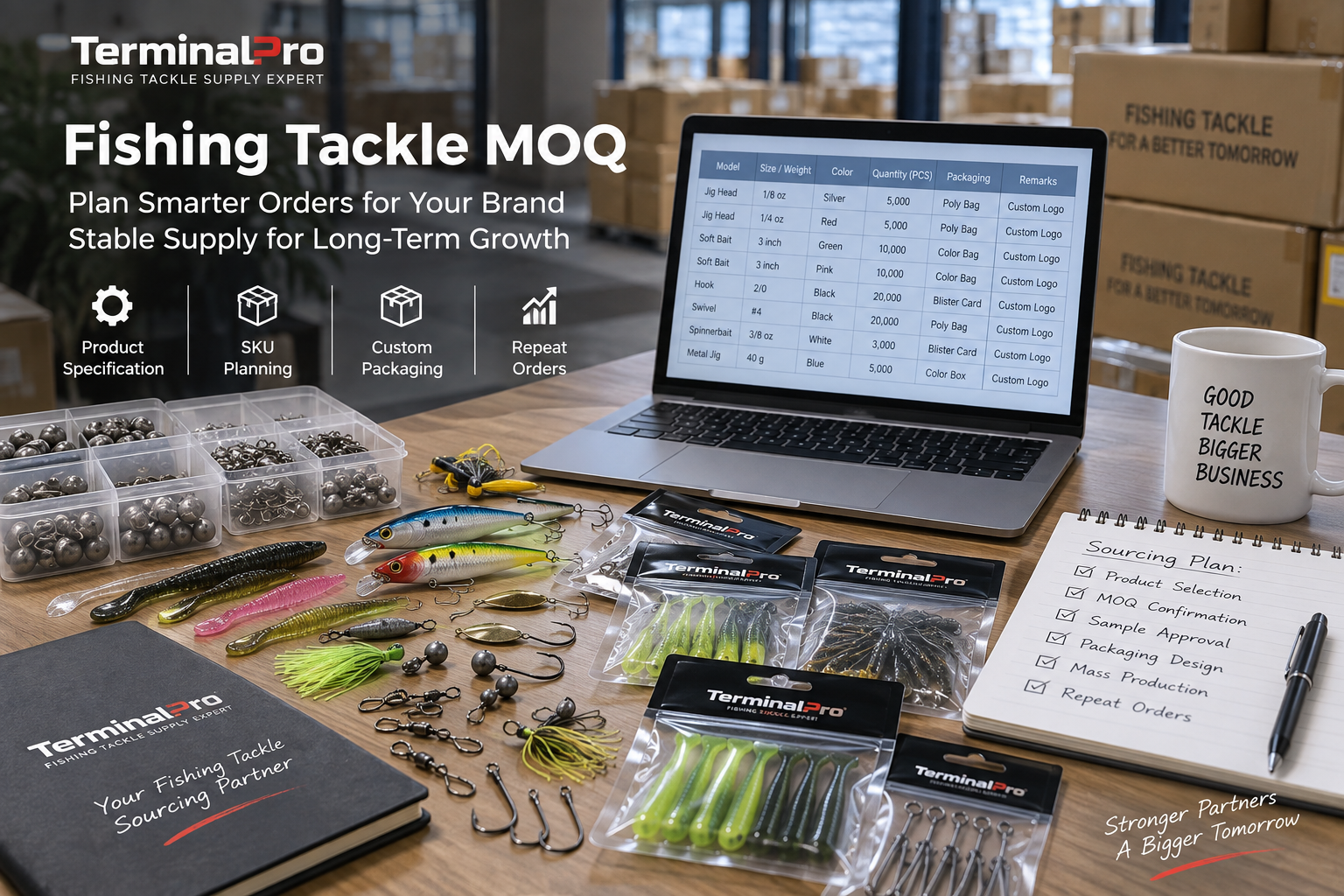
Professional buyers should therefore prepare a SKU table before requesting the final quotation.
It should show model, size or weight, color, quantity, pack count and packaging type.
This gives both sides a much clearer view of the real production requirement.
3. Existing Products Usually Have a Different MOQ Structure From New Developments
The product route has a major effect on fishing tackle MOQ.
An existing product using an established mold, standard finish and normal packaging is usually easier to arrange
than a completely new design.
A modified product may require a different coating, hook, blade, skirt, color or component.
This can create additional production minimums even when the basic mold already exists.
A completely new jig head, sinker, soft bait or lure body may involve tooling, sample development and production setup.
For this type of project, MOQ should be reviewed together with mold cost and expected future volume rather than as an isolated number.
Buyers can review these different routes on our
OEM fishing tackle solutions page.
4. Packaging May Have Its Own MOQ
One of the most common sourcing mistakes is assuming that the product MOQ and packaging MOQ are the same.
They often are not.
Printed bags, blister cards, header cards, insert cards, color boxes and other retail packaging may be produced by a separate packaging supplier.
That supplier may have its own printing setup and minimum quantity.
This means a fishing tackle order may be technically possible at one quantity while the custom package requires a larger print run.
The buyer then needs to decide whether to increase the product quantity, keep surplus packaging for repeat orders,
or use a simpler packaging route such as a standard bag with a branded label.
For more detail, see our
custom fishing tackle packaging options.
5. Different Fishing Tackle Categories Create Different MOQ Pressures
MOQ should be evaluated according to how the product is made.
Small metal components such as swivels, snaps and hooks may be produced efficiently in large quantities,
while the main purchasing decision is often how many sizes and finishes are included in the order.
Jig heads and sinkers introduce different issues.
Weight range, mold structure, hook matching, coating and packing quantity can divide one product family into many production combinations.
Soft baits often involve shape, color, glitter, scent, softness and packaging combinations.
Hard baits and metal lures may involve painting patterns, hardware and hook specifications.
Fishing tools may have fewer individual pieces per order, but handle color, logo method and blister packaging can still affect the minimum.
For this reason, experienced buyers should not expect one universal fishing tackle MOQ across every category.
6. Build the Order Around Core SKUs First
A common procurement problem is trying to launch too many combinations at the same time.
This spreads volume across many slow-moving SKUs and makes the first production order unnecessarily complicated.
A better approach for distributors is to identify core products first.
These are normally the sizes, weights or colors expected to generate the strongest repeat demand.
Supporting SKUs can then be added in smaller proportions where the production route allows it.
For example, a jig head program may use several core weights in higher quantities and keep less common weights more limited.
A swivel range may focus volume on the sizes used most frequently in the buyer’s market.
MOQ planning is therefore closely connected to assortment planning.
The objective is not simply to satisfy the factory minimum.
It is to create an inventory structure that can be reordered efficiently.
7. Do Not Evaluate MOQ Without Looking at Unit Cost
Reducing MOQ may increase the unit cost.
Shorter production runs can create more setup cost per piece,
while small packaging quantities can increase printing cost.
Buyers should compare several quantity levels when the project is commercially important.
A slightly larger order may produce a meaningful unit-cost improvement,
especially when the same tooling, coating setup or packaging preparation is required.
However, buying more only to obtain a lower unit price can also create unnecessary inventory.
The better decision is based on expected sales, reorder timing, storage cost and cash flow.
In professional sourcing, the lowest unit price and the lowest total purchasing risk are not always the same thing.
8. Packaging and Product Quantities Should Be Planned Together
Retail packaging directly affects SKU structure.
If every size or color uses a unique printed card or printed bag,
the number of packaging SKUs may quickly become similar to the number of product SKUs.
Importers can sometimes simplify this by using one common package design with variable barcode,
size or weight labels.
This reduces the number of printed packaging versions and can make future replenishment easier.
Packaging planning should therefore happen before mass production, not after the products are completed.
TerminalPro follows the same principle in our
process and quality workflow.
9. Sample Quantity Is Not the Same as Production MOQ
Buyers occasionally assume that because a supplier can provide a few samples,
the same product can also be produced commercially in a very small quantity.
That is not necessarily the case.
Samples may come from existing stock, previous production or a dedicated sample process.
Bulk production may require material preparation, machine setup, coating, assembly, packaging printing or other production steps.
Samples should therefore be used to confirm specification, appearance, function and packaging direction.
Production MOQ should be discussed separately once the approved specification is clear.
10. Plan MOQ With Repeat Orders in Mind
The strongest fishing tackle sourcing programs are usually built around repeatability rather than one isolated order.
When buyers expect regular replenishment, both sides can make better decisions about packaging stock,
approved samples, production references and SKU planning.
Keeping an approved reference sample is especially useful.
For future orders, it provides a physical standard for size, weight, color, finish, hook, hardware and packaging.
Our
fishing tackle quality control process also uses product-specific checkpoints
because the important inspection points differ between swivels, hooks, jig heads, soft baits, sinkers and tools.
A good MOQ discussion therefore includes the expected reorder cycle.
The buyer may decide to order more of core SKUs, less of secondary SKUs and retain surplus printed packaging for future production.
Fishing Tackle MOQ Checklist Before Requesting a Quote
| Item | What the Buyer Should Confirm |
|---|---|
| Product | Exact product type, model or catalog reference. |
| Specification | Size, weight, hook, material, finish, color or other key details. |
| SKU Structure | Quantity per size, weight, color and model. |
| Customization | Existing product, modified product or new development. |
| Packaging | Bulk, bag, label, header card, blister or box. |
| Branding | Logo, barcode, SKU, country-of-origin text and artwork status. |
| Samples | Existing sample, custom sample or approved reference requirement. |
| Order Quantity | Total order quantity and quantity per SKU. |
| Reorder Plan | Expected replenishment volume and timing. |
| Target Market | Destination market and any relevant product or packaging requirements. |
How TerminalPro Reviews Fishing Tackle MOQ
TerminalPro works with fishing tackle brands, importers, wholesalers and distributors through long-term partner factories in China.
Different categories have different production realities, so we do not apply one universal MOQ rule to every fishing tackle product.
For standard products, buyers can begin with our
online fishing tackle catalogs
and send the product codes, quantities and packaging requirements they need.
For modified products or new developments, we review the product specification,
production route, tooling requirement, packaging and expected quantity before confirming a practical quotation.
This approach is especially useful for buyers combining several product categories in one purchasing program,
including jig heads, lead products, spinnerbaits, metal jigs, swivels, snaps, fishing hooks, sinkers and fishing tools.
Conclusion
Fishing tackle MOQ should be treated as part of procurement planning rather than only as a number to negotiate.
Product type, SKU count, color, weight, finish, tooling, packaging and future reorder volume can all change the most practical order structure.
For importers and distributors, the best approach is to define core SKUs,
prepare clear quantities per specification and confirm packaging before asking suppliers for a final quotation.
This produces more comparable pricing and reduces unnecessary changes later in the project.
If you are preparing a fishing tackle wholesale or OEM order,
send TerminalPro your product list, target quantity per SKU and packaging idea.
We can review the project and suggest a practical sourcing route before quotation.
Need a Fishing Tackle MOQ and Quotation Review?
Send us your product photos, catalog codes, size or weight list, quantity per SKU and packaging requirements.
TerminalPro will review the product structure, production route and packaging requirements before preparing a quotation.
FAQ About Fishing Tackle MOQ
What is the typical fishing tackle MOQ?
There is no single MOQ for all fishing tackle products.
The minimum depends on product category, production method, specification, customization and packaging.
Buyers should confirm whether the quoted MOQ applies to the total order, each model, each size, each color or each SKU.
Why does private label packaging affect MOQ?
Custom printed bags, cards, boxes and blister packaging may have their own printing minimums.
The packaging MOQ can therefore be higher than the product production MOQ.
Can several fishing tackle SKUs be combined in one order?
In many cases, yes, but the practical quantity depends on the production requirements of each product.
A combined order does not automatically remove the minimum quantity required for each model, size, finish or production process.
Does using an existing product reduce MOQ?
Existing products are generally easier to arrange because tooling and basic production specifications already exist.
However, custom color, coating, components or packaging may still create separate minimum quantities.
What information should importers send when asking about MOQ?
Send the product photo or catalog code, specification, quantity per SKU, packaging method,
branding requirement and expected reorder volume.
Clear information allows the supplier to give a much more practical MOQ and quotation.